
Tire & Wheel Guides
How to Calculate Wheel Offset on a Car Without Mistakes
Wheel offset calculation: a simple method to pick the right ET, avoid rubbing, and keep a safe, compatible fitment.
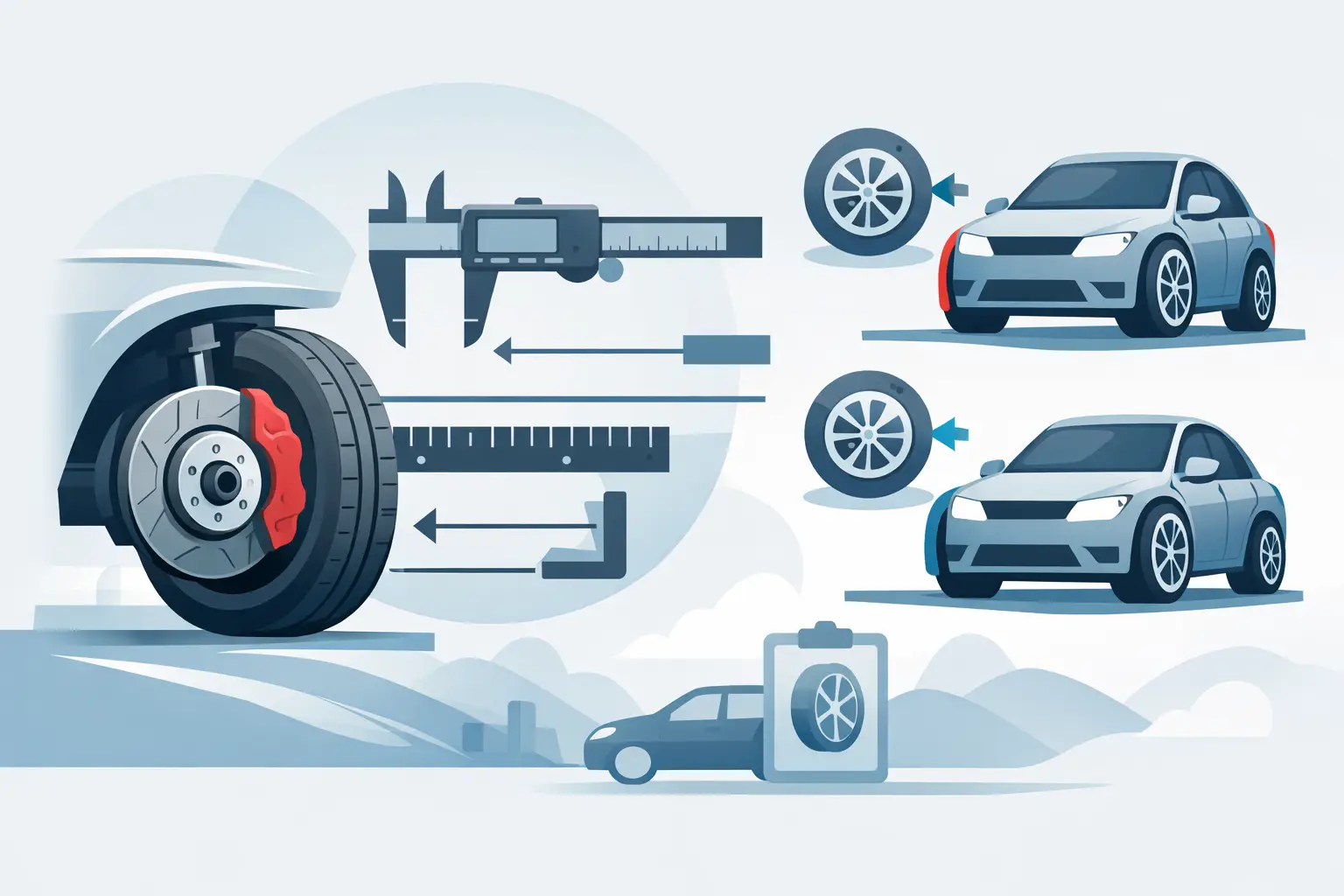
You've found a great-looking set of wheels, the size looks right, the bolt pattern matches too, but there's still one detail that often derails the purchase: the wheel offset calculation. That's frequently where compatibility is truly decided. A wheel with the wrong offset can rub against the fender, hit the suspension or stick too far out from the vehicle, even when the diameter and width seem correct.
Offset, also called ET, indicates the position of the wheel's mounting surface relative to its centreline. Put more simply, it determines whether the wheel sits further in toward the suspension or further out toward the exterior. It's a technical figure, but it has very real effects on how the vehicle behaves, on clearance space and on the safety of the installation.
Calculating car wheel offset: understanding what you're measuring
Offset is expressed in millimetres. When the offset is positive, the mounting surface is shifted toward the outside of the wheel, which tucks the wheel further into the wheel well. When it's negative, the wheel sticks out more. An offset of 0 places the mounting surface exactly at the centreline.
Take a wheel that's 8 inches wide. Its theoretical centre sits at 4 inches. If the mounting surface is located 20 mm toward the outside relative to that centre, the offset is +20. If it's 10 mm toward the inside, the offset is -10.
This number isn't picked at random by the manufacturer. It's tied to the vehicle's geometry, to the space available near the brakes, the shocks and the fenders, as well as to the stability the vehicle is designed for. That's why you don't swap one offset for another simply because the wheel "fits" on the hub.
Why offset changes everything
A change in offset alters the position of the entire wheel relative to the vehicle. If you reduce the offset too much on a wheel of the same width, the wheel sticks out further. The look might appeal to you, but you also increase the risk of rubbing on the fender, especially with wider tires or when the suspension is working.
Conversely, an offset that's too high pushes the wheel inward. There, the problem shifts over to the strut, the brake calipers or the steering arm. In some cases, the wheel can physically be mounted but lacks clearance in real-world driving.
You also have to consider that offset influences the load applied to certain components. The further you stray from the intended specs, the more you can affect the bearings, the steering and the road behaviour. For an everyday vehicle, especially in Quebec conditions, the best choice is generally a fitment close to the recommended specifications.
The basic formula for calculating car wheel offset
The calculation is based on two measurements: the actual width of the wheel and the distance between the back of the wheel and the mounting surface, which is often called the backspacing.
The formula is simple:
Offset = backspacing - half of the total width of the wheel
Then you have to convert the result to millimetres if the measurement was taken in inches. One inch equals 25.4 mm.
A concrete example. You have a wheel that's 8 inches wide. Half gives you 4 inches. If the measured backspacing is 5.5 inches, the calculation gives you 1.5 inches. Converted to millimetres, that comes to 38.1 mm. So the offset is about +38.
This method is handy for checking an existing wheel when the ET marking isn't legible, or to compare two configurations before buying.
Watch out for the measured width
This is where several mistakes happen. The nominal width of a wheel, 8 inches for example, corresponds to the distance between the tire bead seats, not necessarily the total width from one lip to the other. If you physically measure the complete wheel, you can end up with a slightly larger value. So you need to know which reference you're using in order not to throw off the calculation.
If you're comparing two wheels on the market, use the manufacturer's technical data as much as possible. It's more reliable than a measurement taken quickly with a tape.
How to compare a new offset with the original
In real life, the calculation isn't just for reading an ET. Above all, it's for comparing the position of a new wheel with the old one. That's where you can see how much the wheel will tuck in or stick out.
Suppose your original wheel is a 17x7 with an offset of +45, and you want to move to an 18x8 with an offset of +35. You're changing both the width and the offset. The new wheel is one inch wider, so it adds roughly 12.7 mm on each side from the centre. Since the offset drops by 10 mm, the wheel also sticks out 10 mm more toward the outside.
Practical result: the outer edge of the new wheel ends up about 22.7 mm further out than before, while the inner edge moves closer to the suspension by only about 2.7 mm. This kind of comparison is far more useful than a single ET figure taken in isolation.
The simple rule to remember
If the width stays the same, every 5 mm drop in offset pushes the wheel out by about 5 mm. Every 5 mm increase tucks it in by about 5 mm. When the width changes too, you have to add or subtract half the gain in width to understand the new position.
Common mistakes when choosing a wheel
Many drivers check only the diameter, like 17 or 18 inches, and then the tire width. That's not enough. A compatible wheel also has to respect the right bolt pattern, the right centre bore, the load capacity and an appropriate offset.
Another common mistake: believing that a small offset difference is always harmless. Sometimes it is, sometimes it isn't. A change of 3 to 5 mm can be acceptable on some vehicles with enough clearance. On others, especially if the brakes are large or the tire is wider, that small gap is enough to create rubbing.
You also have to be wary of setups seen online. A wheel that works on a specific model with the original suspension can become a problem on the same vehicle once it's lowered, loaded or fitted with a different tire.
When a different offset can still work
There's no perfect universal number. There's a reasonable range depending on the vehicle, the wheel width and the use. For a replacement fitment close to original, you usually want to stay very close to the manufacturer's specs. For a more custom fitment, you can adjust the offset, but only after validating the inner and outer clearances.
On a sport utility vehicle or a light truck, some drivers want a wheel that sticks out more for looks or to clear certain components. That's possible, but you have to accept the trade-offs: more pronounced spray, different stress on certain components, a risk of contact under steering or compression, and sometimes more questionable compliance depending on the setup.
On a sedan or a crossover used every day, especially in winter, a clean fitment close to original often gives the best results. You reduce surprises, you keep more predictable handling and you simplify the seasonal installation.
Which method to use before buying
The best approach is to start from the vehicle's original configuration, then compare the new wheel on three points at the same time: width, offset and tire size. If only one of the three changes, the impact sometimes stays limited. If all three change together, the margin for error becomes much smaller.
In a quick-purchase situation, use the exact specifications of the vehicle and of the wheels you're considering. Then check the space on the suspension side, the space on the fender side and the brake clearance. If you're also changing the tire, take into account the actual bulge of its sidewall, because a tire can extend past the width of the wheel and create contact even when the wheel alone seemed fine.
This is also where a specialized retailer saves you time. At Liqui Pneus, the value of a compatibility tool or a technical validation isn't theoretical. It avoids an order that won't mount, a needless return or a compromised installation once the vehicle is back on the ground.
Offset, safety and driving in Quebec
Here, the roads don't forgive approximate fitments. Between the potholes, the temperature swings, the more aggressive winter tires and suspensions that are already under strain, a poorly positioned wheel can quickly reveal its flaws. Slight rubbing in the garage can turn into a real problem with four passengers, a loaded trunk or a full steering maneuver in the slush.
The right offset helps maintain stable behaviour, sufficient clearance and more predictable wear. It's not just a matter of looks. It's a matter of real-world fit, especially when you want to buy a wheel once and stop thinking about it at every season change.
If you're hesitating between two offsets, don't choose at random. Compare the wheel's actual position, take the intended tire into account and validate the full compatibility of the fitment. A good calculation today saves you rubbing, returns and needless costs tomorrow.