
Tire & Wheel Guides
How to Choose Winter Tires Without Making a Mistake
How to choose winter tires in Quebec: size, rating, traction, driving habits and budget. The criteria that actually matter so you buy right this winter.
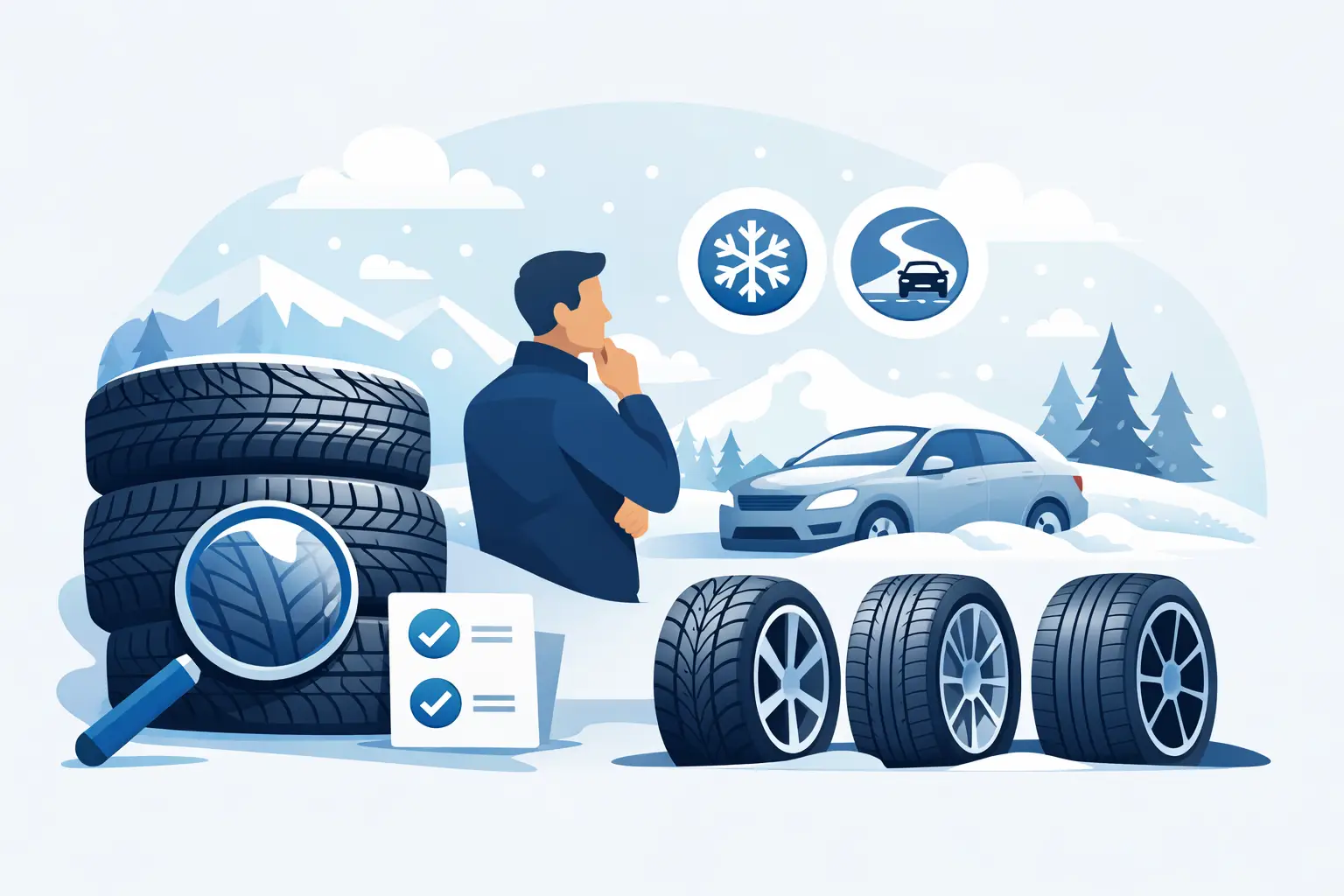
The first real test of a winter tire isn't the first snowfall. It's the icy, slushy morning at -12 °C, on a side street that hasn't been plowed yet, when you need to brake short without losing control. If you're wondering how to choose winter tires, you have to look at a lot more than the price or the brand name on the sidewall.
In Quebec, a good choice depends on your vehicle, your typical trips, your tolerance for noise, your budget and the level of grip you actually want. Two winter-rated tires can behave very differently on cold pavement, packed snow or slush. So the goal isn't to grab the most popular model. It's to choose the one that matches exactly how you drive.
How to choose winter tires based on how you drive
The most overlooked criterion is how the vehicle is really used. A driver who mostly does city kilometres in Laval doesn't have the same needs as someone who hits the highway every week or drives less-maintained roads on the outskirts.
If you do short urban trips, you'll want to prioritize traction off the line, stability under low-speed braking and a tire that stays supple in deep cold. If you're often on the highway, road holding, steering precision and stability at sustained speed become more important. And if you regularly take snow-covered roads, pay special attention to how well the tire clears snow and pulls in tough conditions.
This is also where the trade-off between comfort and performance comes in. Some winter tires are very effective in deep snow but can be noisier or less precise on dry pavement. Others are more stable and pleasant day to day, but a little less aggressive in the most extreme conditions.
Confirm the right tire size first
Before comparing models, you need to confirm the approved size for your vehicle. That's the foundation. An excellent tire in the wrong size is still a bad purchase.
A tire size looks something like 205/55R16. Every part matters. The width affects the contact patch, the profile affects handling, and the diameter absolutely has to match the wheel. You also need to check the load index and speed rating recommended for your vehicle.
In winter, some drivers choose a smaller wheel and tire size to cut costs and improve behaviour in snow. That's often a smart strategy, but only if the alternative size is compatible with the vehicle, the brakes and the clearance required. It's not a decision to make blind.
The winter symbol isn't enough on its own
A lot of customers stop their search the moment they see the three-peak mountain snowflake symbol. That marking is essential, but it doesn't tell the whole story.
Yes, it confirms the tire meets a recognized winter performance standard. No, it doesn't guarantee that every tire marked for winter is equal. Between an entry-level model and a premium tire, the differences can be clear when it comes to braking, noise, wear and stability on cold roads.
The rubber compound, the density of the sipes, the shape of the tread blocks and the ability to clear water and slush vary a lot from one model to the next. It's often in these details that the difference is decided between a tire that's simply compliant and one that's genuinely reassuring.
Prioritize the right performance criteria
When it's time to compare, avoid putting everything on the same level. Some criteria have a direct impact on safety, while others are mostly about comfort.
Braking on ice and on cold pavement should always rank very high in your priorities. Traction off the line matters too, especially if you have a front-wheel-drive vehicle or you often park on snow-covered streets. Lateral grip in corners is important for keeping behaviour predictable on on-ramps, at intersections and during lane changes.
After that come criteria more tied to the driving experience, like rolling noise, suppleness, steering response and lifespan. A very aggressive tire can be effective in snow but noisier and sometimes a little less refined on clear asphalt. Conversely, a more road-oriented model may suit a mixed daily routine better if you mostly drive roads that are cleared quickly.
Budget: where to save, where not to cut
Price matters, but you have to read it correctly. A tire that's cheaper to buy isn't automatically more economical. If it wears out fast, brakes less well or gets noisy quickly, the initial savings can disappear.
The right instinct is to compare overall value. Look at the reputation for winter consistency, the expected lifespan, the level of comfort and the intended use. For a vehicle you keep for several seasons, a better-suited model is often more cost-effective than a purchase based only on the deal of the moment.
You also need to think about the total cost. Dedicated winter wheels make seasonal swaps simpler and protect your main rims. Storage, installation and balancing are also part of the decision. For many drivers, keeping the purchase and the service in one place is mainly about avoiding mistakes and wasted time.
The right tire for your type of vehicle
A subcompact, an SUV and a light truck don't call for the same approach. The vehicle's weight, height, drivetrain and intended use change the ideal choice.
For a compact or mid-size car, you're usually looking for a balance between safety, comfort and price. For an SUV, stability, grip on variable surfaces and the ability to handle the weight become more important. For a pickup or a utility vehicle, you need to watch the load index closely, along with the toughness of the carcass and the tire's ability to stay stable under load or in more demanding use.
Another point that's often misunderstood concerns all-wheel-drive vehicles. AWD helps you get moving, but it doesn't shorten braking distances. This type of vehicle still needs high-performing winter tires, and ideally four tires of the same model with comparable wear, to keep behaviour balanced.
When to replace your winter tires
Choosing a good tire also means knowing when a tire is no longer at its best. Many drivers wait too long.
Even if the tread depth still looks acceptable, an older winter tire can lose some of its suppleness. The rubber hardens over time, which hurts grip in cold weather. If you notice a drop in traction, longer braking distances or uneven wear, it's better to have the full set checked.
Wear should also be even. Uneven wear can point to a pressure, alignment or suspension problem. In that case, replacing only the tires without fixing the cause risks repeating the same problem the following winter.
Common mistakes to avoid when buying
The first mistake is choosing on price alone. The second is going with a different size without validation. The third, very common one is buying a tire that's too geared toward a use that doesn't match yours.
There's also the idea that a winter tire that performs very well in deep snow is necessarily the best for everyone. Not necessarily. If you mostly drive well-plowed routes, a quieter model that's more stable on cold pavement can be a better everyday choice.
Another classic mistake is waiting until the last minute. The further the season goes, the more availability changes. Buying early often lets you compare better, find the right size and plan the installation without stress.
How to choose winter tires quickly and correctly
If you want to cut straight to it, start with four pieces of information: the year, make and model of the vehicle, the compatible tire size and the type of trips you make. From there, it becomes much simpler to rule out the models that don't fit.
Next, rank your real priorities. If your number one priority is braking on ice, say so. If you mostly want a quiet tire for long daily commutes, that's a different need. If you're after the best value with installation and storage in the same place, that constraint matters in the right choice too.
With a structured retailer like Liqui Pneus, the advantage isn't just having a wide selection. It's being able to compare compatible options, quickly validate the specs and move from selection to booking an appointment without piling on extra steps.
A well-chosen winter tire rarely gets noticed when everything is fine. It gets noticed most when the road turns unpredictable and you need a sharp, stable, reassuring response. That's where the right choice truly makes the difference.