
Tire & Wheel Guides
How to Measure a Bolt Pattern the Easy Way
Learn how to measure a bolt pattern correctly so you can pick the right wheels with no mistakes, using the proper method based on the number of lug holes.
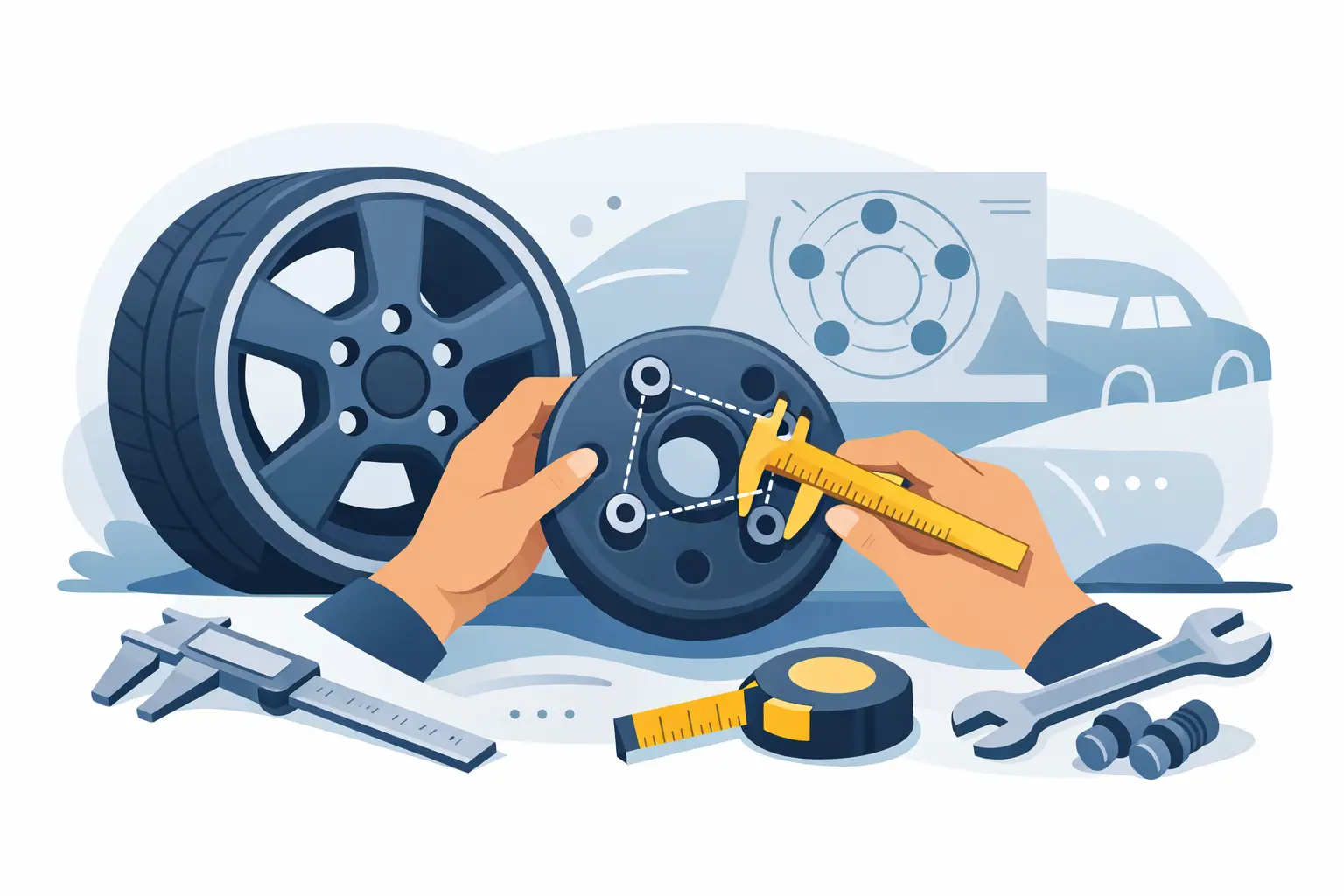
You found a set of wheels you like, the width is right, the diameter checks out too, but one detail can sink the whole thing at installation time: the bolt pattern. If you're wondering how to measure a bolt pattern, the smart move is to never guess. A few millimetres of error is all it takes to make a wheel incompatible, even when everything else looks correct.
The bolt pattern, also called the lug pattern or pitch circle, comes down to two precise pieces of information: the number of mounting holes and the diameter of the imaginary circle those holes sit on. That's what gives you formats like 5x114.3, 4x100 or 6x139.7. The first number is the count of holes. The second is the diameter, in millimetres, of the bolt circle.
How to measure a bolt pattern without getting it wrong
The method depends first on the number of holes on the wheel or hub. This is where a lot of mistakes start, because you don't measure a 4-hole wheel exactly the same way you measure a 5-hole one.
Before you begin, grab an accurate measuring tape or, ideally, a vernier caliper. Measuring directly on a wheel that's still mounted on the vehicle can work, but the reading is often less clean. If the wheel is off, it's much easier.
Measuring a 4, 6 or 8-hole bolt pattern
For wheels with an even number of holes, the measurement is straightforward. You measure from the centre of one hole to the centre of the hole directly across from it. That distance is the diameter of the bolt circle.
For example, if you have 4 holes and the distance from the centre of one hole to the centre of the opposite hole is 100 mm, the bolt pattern is 4x100. If you have 6 holes and a reading of 139.7 mm, you're looking at a 6x139.7, a common format on certain trucks, SUVs and trailers.
The key point here is to start from the centre of a hole, not edge to edge. A measurement taken on the outer edges can push you toward the wrong model.
How to measure a 5-hole bolt pattern
The 5-hole pattern is the one that causes the most confusion. Since there's no hole directly across from another, you can't measure symmetrically from one centre to another the way you can on a 4-hole or 6-hole wheel.
On a 5-hole wheel, you measure from the centre of one hole to the outer edge of the farthest hole, the one that sits almost across from it. This method gives you the bolt circle value. Depending on how precise you need to be, a dedicated gauge or a vernier caliper helps a lot, especially between close formats like 5x112 and 5x114.3.
That's exactly where you have to be careful. By eye, those two patterns can look almost identical. In practice, they aren't, and forcing an installation is a bad idea for safety, for the studs and for how the wheel seats.
The most common formats in Quebec
On passenger vehicles, you'll often see 4x100, 5x100, 5x10⁸, 5x112, 5x114.3 and 5x120. On the pickup, SUV, trailer and heavier-duty side, 6x139.7 and 8x165.1 also come up regularly.
That said, you should never pick a wheel just because a format is common for a given brand or vehicle type. Two versions of the same model can differ depending on the year, the engine, all-wheel drive or the brake package. The bolt pattern is part of compatibility, but it's not the only criterion.
What to check beyond the bolt pattern
A wheel can have the right bolt pattern and still be incompatible. That happens a lot when you rely on a single measurement.
The wheel's diameter and width obviously have to suit the vehicle and the tire you've chosen. Offset, also called inset, changes where the wheel sits relative to the hub and the fender. The wrong offset can create rubbing, alter handling or interfere with brake clearance.
The centre bore is another point that often gets overlooked. If the wheel's centre opening is too small, it won't fit. If it's larger, centring rings may be needed to ensure a proper fit depending on the application.
You also have to account for the bolt or lug nut seat type. Conical, ball or flat, this detail affects torque and how the wheel seats. Even with the right bolt pattern, the wrong hardware can compromise the installation.
How to avoid the most common measuring mistakes
The first mistake is measuring with a tool that's too rough. An old flexible tape can do in a pinch, but if you're comparing very close formats, it often lacks the precision you need.
The second mistake is mixing up inches and millimetres. A lot of trailer applications and older vehicles use references that still circulate in both systems. You need to stick to one unit for the whole check.
The third mistake is measuring the wheel while it's dirty, rusty or still fitted with caps that hide part of the holes. A quick clean makes the reading far more reliable.
The fourth mistake, and the more expensive one, is assuming that if a wheel "almost fits," it'll do the job. A wheel that doesn't line up perfectly isn't compatible. You don't fix a wrong bolt pattern with force.
Measuring on the wheel or on the vehicle
Both approaches work. On a wheel that's off the vehicle, the measurement is easier and more visible. On the vehicle's hub, you can also check the bolt pattern directly if the wheel is off for a seasonal swap or a brake job.
Measuring on the hub has a practical advantage: you're validating the actual vehicle, not just a wheel that may already have been swapped by a previous owner. That's useful on used vehicles, trailers and sets of wheels you've picked up secondhand.
When it's better to validate than to measure
If you have the exact year, make, model and trim of the vehicle, a compatibility lookup is often faster than measuring by hand alone. That's especially true for customers who want to buy wheels without a lot of trial and error.
Measuring it yourself helps you better understand what you've got in front of you. That said, as soon as you're talking about a complete wheel-and-tire package, you need to confirm every parameter: bolt pattern, offset, centre bore, load rating and component clearance. That's even more true in Quebec, where many drivers switch from a summer set to a winter set and want to avoid nasty surprises at their first installation appointment.
How to measure a bolt pattern on a trailer or ATV
The principle is the same, but you have to be even more careful about units and existing formats. Trailers often use specific patterns, sometimes visually close to automotive formats without being identical. ATVs and certain utility vehicles add their own quirks depending on the brand and the use.
In those cases, the wheel's load rating matters just as much as the bolt pattern. A wheel that mounts up correctly but isn't built for the real load isn't a good solution. For a work or towing application, you should always treat compatibility as a full technical package, not a single measurement.
The smart move before buying wheels
If you're changing your wheels, especially to move to a different wheel style or a different size, take an extra two minutes to confirm all the specs. That's often what saves you a return, a wasted appointment or an install that simply can't be done in the shop.
At Liqui Pneus, this is exactly the kind of check that saves customers time. The bolt pattern is the foundation, but an exact choice always comes down to full compatibility validated against the vehicle.
When you measure, keep it simple and precise. Count the holes, use the right method for the number of fasteners, then check the rest of the equation. A compatible wheel should never be a gamble.