
Tire & Wheel Guides
Tire Size Equivalence: How to Choose the Right Fitment
Understand tire size equivalence so you can switch fitments without errors. Width, aspect ratio, overall diameter, and tolerance explained in plain terms.
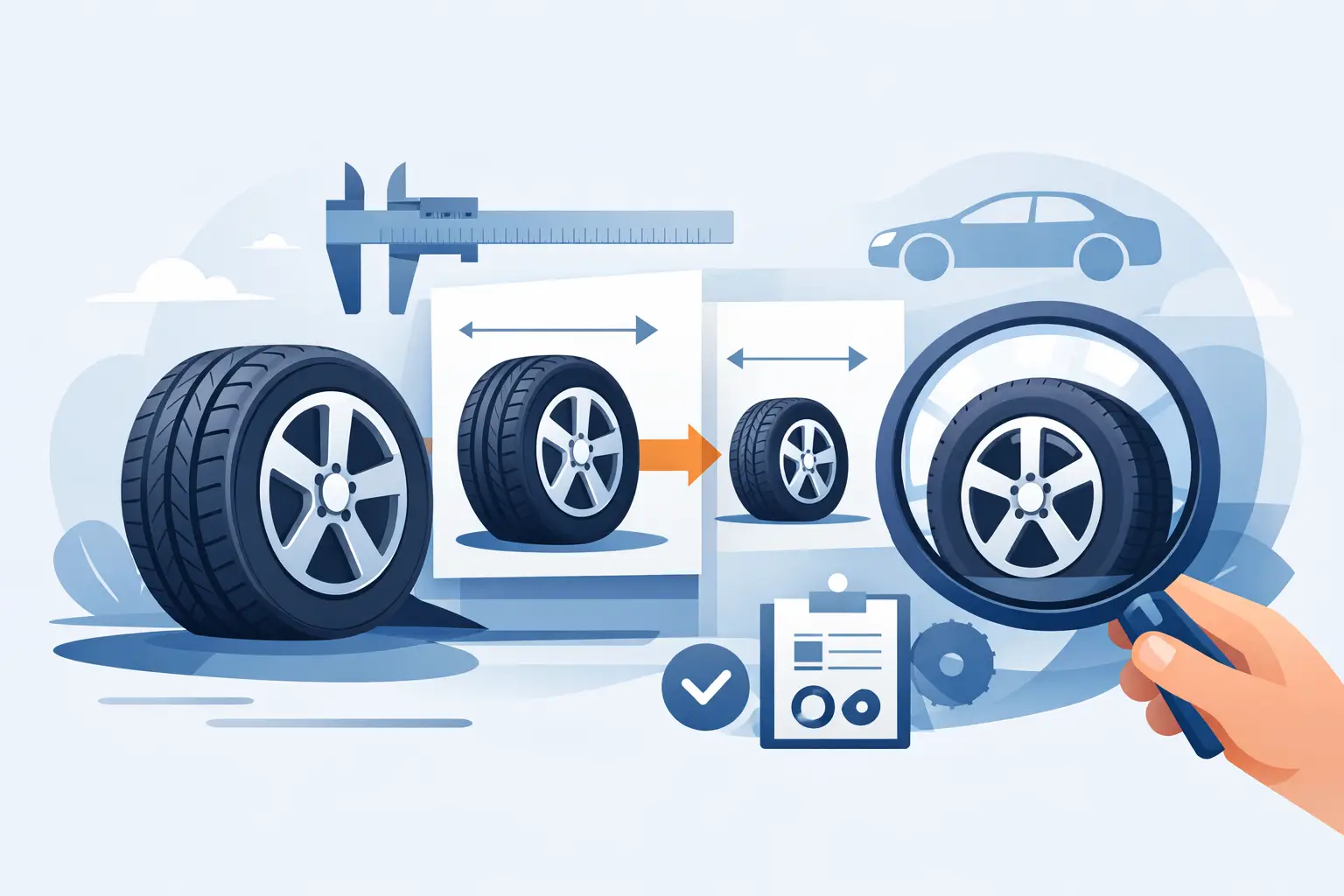
You spot a tire listed as 205/55R16, but the model that's on sale comes in 215/50R17. Is it compatible or not? The whole question of tire size equivalence starts right there: changing a size without throwing off the overall diameter, the road manners, or the speedometer reading. A mistake can get expensive in terms of comfort, wear, and safety. A proper equivalence, on the other hand, lets you move to a different tire or wheel size without guessing.
The goal isn't simply to find a tire that "fits" inside the fender. You have to keep a balance between width, sidewall height, rim diameter, load capacity, and speed rating. In Quebec, where we swap from winter tires to summer tires and the roads don't always forgive, this technical detail becomes very real.
What is tire size equivalence?
Tire size equivalence means replacing one factory size with another while keeping the overall diameter very close to the original. Why does that matter? Because the diameter directly affects the speed shown on your dashboard, the ABS, the traction control, the clearance in the fenders, and the overall behaviour of the vehicle.
Let's take a simple example. A 205/55R16 tire has a width of 205 mm, an aspect ratio of 55%, and mounts on a 16-inch rim. If you move up to a 17-inch rim, you generally need to reduce the sidewall height to compensate for the larger wheel diameter. That's where size equivalences come into play.
In practice, you usually want to stay within a variation of about 3% or less compared to the original overall diameter. The smaller the gap, the more you protect the vehicle's accuracy and ride quality. That said, an equivalence that works on paper isn't automatically the right option. You also have to check the rim width, the clearance, the suspension, and the manufacturer's specifications.
How to read a tire size
Before talking about equivalence, you need to decode the format. A marking like 225/45R17 gives you three basic pieces of information.
The first number, 225, is the tire width in millimetres. The second, 45, is the sidewall height as a percentage of the width. The R indicates radial construction, which is the norm on modern vehicles. The last number, 17, is the rim diameter in inches.
On top of that you'll often see the load index and the speed rating, for example 94H. This information isn't an afterthought. Even if the diameter is right, a tire with insufficient load capacity is not an acceptable choice.
Why switch to an equivalent size?
The most common reason is a wheel change. Plenty of drivers want a different wheel for summer or for winter. Others are looking for a size that's more available, a better price, or a wider selection of models.
There are also cases where a factory size becomes less appealing. Some rare sizes cost more or limit your options for winter tires. An equivalent size can then offer better value, as long as it's validated properly.
The takeaway is simple: changing sizes isn't automatically a bad idea. The real risk is doing it without any calculation or verification.
The basic rules for tire size equivalence
The first criterion is the overall diameter. It has to stay very close to the original size. If the diameter increases too much, the speedometer will show a lower speed than your actual speed. If it shrinks too much, the effect is the opposite. It can also throw off the electronic driver aids.
The second criterion is load capacity. You don't go below the specification required by the vehicle. The same logic applies to the speed rating, especially on heavier or higher-performance vehicles.
The third criterion, often overlooked, is the available clearance. A wider tire or a different rim can rub against the suspension, the caliper, the mud guard, or the inside of the fender, even when the overall diameter is correct.
Finally, you have to consider how you drive. An equivalence that's acceptable on paper can give you a firmer ride, sharper steering, or reduced comfort. For some drivers, that's a plus. For others, it isn't.
Common equivalence examples
A classic case: 205/55R16 to 225/45R17. The overall diameter stays close, which makes it a frequent swap when you go up one inch in rim size.
Another example: 215/60R16 to 225/55R17. Here again, you offset the larger rim diameter with a slightly lower sidewall.
On some SUVs, you'll also see moves from 225/65R17 to 235/60R18. That often makes sense in terms of diameter, but you have to pay closer attention to the width, the vehicle's weight, and the clearance.
These examples make one thing clear: you can't eyeball an equivalence. Two sizes that look close can create too large a gap. Others, on the contrary, are technically very compatible.
What equivalence doesn't solve on its own
Talking about tire size equivalence without talking about the wheel would be incomplete. The tire size has to work with the rim width, but also with the offset, the bolt pattern, and the centre bore when you change the complete wheel.
An equivalent tire mounted on a poorly matched rim can cause just as many problems as the wrong size. The vehicle can vibrate, rub, or react differently under braking. That's even truer on newer vehicles fitted with sensors, larger brakes, or tighter suspension.
You also have to think about the season. In winter, many drivers choose a slightly narrower size to improve traction in the snow. That's often a good strategy, but it has to stay within the vehicle's tolerances.
Common mistakes to avoid
The first mistake is relying only on rim diameter. A 17-inch isn't "equivalent" to another 17-inch if the width and profile change too much.
The second is ignoring the load and speed ratings. A cheaper tire that doesn't meet the vehicle's requirements isn't a saving.
The third is copying the size from another similar vehicle. Two versions of the same model can have different configurations depending on the year, the engine, or the option package.
Finally, many drivers forget the impact on comfort. The more you go up in rim size and the more you reduce the sidewall, the firmer the ride can become. On Quebec roads, that trade-off is worth thinking about.
When a different size can be a smart decision
If you're after better availability, a more competitive price, or a separate set of wheels for winter, a properly calculated equivalence can be a real advantage. That's often the case when a factory size is expensive or hard to find.
It's also useful for tailoring how the vehicle behaves. A slightly wider tire can improve stability on dry pavement, while a more modest size can preserve comfort and lower the cost of replacement. There's no single right answer. It depends on the vehicle, the budget, and how you actually drive.
For a city driver who mainly wants to get through winter without any nasty surprises, the priority won't be the same as for someone who racks up highway kilometres or is chasing a sportier feel. The right choice is the one that respects the specifications while still making sense for your driving.
How to validate the right equivalence
The safest method is to start from the original size listed on the vehicle's placard or recommended by the manufacturer. Then you compare the overall diameter, the load, the speed, and the compatibility with the rim.
If you're changing the wheels too, you need to add a check of the bolt pattern, the offset, and the brake clearance. That's exactly the kind of situation where a compatibility tool or a check by a specialist saves time and avoids a costly return.
For a quick and accurate purchase, the best habit is to treat the size as a complete set of technical data, not just a number you glanced at on the sidewall. At Liqui Pneus, that approach makes all the difference between an install that works the first time and a choice that complicates the fitment.
A well-chosen equivalent size isn't about getting around the rules. It's about getting the right tire, in the right size, for the right use. When the numbers are validated properly, you gain in simplicity, in safety, and often in value when it's time to buy your next set.