
Tire & Wheel Guides
Vehicle-Compatible Wheels: What to Check Before You Buy
Find wheels that truly fit your vehicle without a costly mistake. Diameter, bolt pattern, offset, centre bore, and load rating are the specs to confirm before you buy.
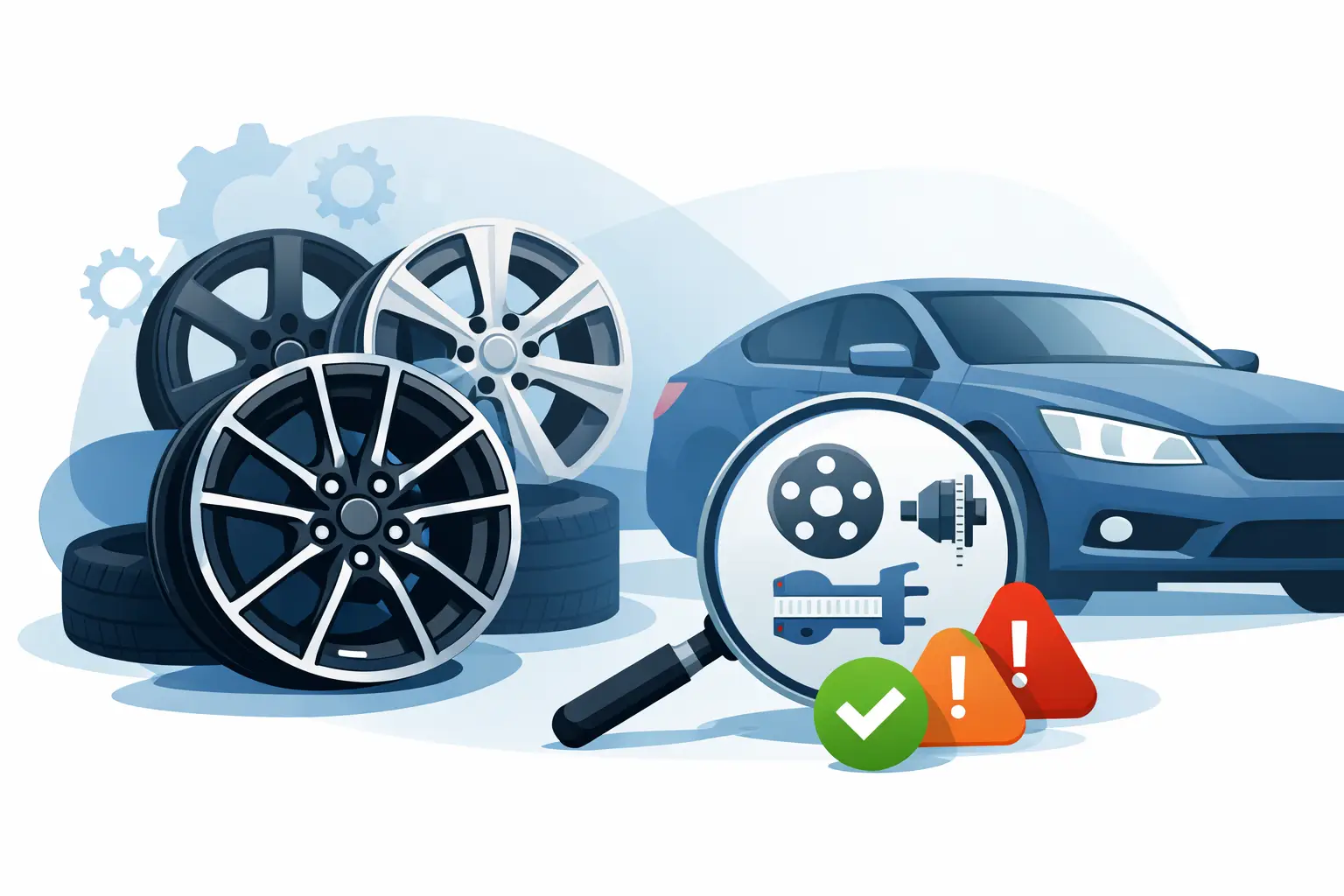
Swapping wheels without confirming compatibility is the fastest way to waste your time and your money. When it comes to vehicle-compatible wheels, it isn't enough for the diameter to just "look about right." A wheel can have the right style and even the right overall size while still being impossible to install correctly, causing rubbing, abnormal wear, and disappointing road manners.
To avoid all that, you need to look at the right specs from the very start. The goal isn't to make the purchase complicated. Quite the opposite. When the measurements are right, the choice becomes simpler, the installation goes off without a hitch, and the vehicle keeps behaving safely, summer and winter alike.
Vehicle-compatible wheels: the criteria that really matter
A wheel's compatibility comes down to a set of precise measurements. Diameter and width are often the first numbers people know, but they aren't the only ones that decide whether the wheel actually suits the vehicle.
The bolt pattern is an essential starting point. It tells you the number of bolts and the distance between them. A 5x114.3 wheel, for example, doesn't automatically replace a 5x112. To the eye, the difference can look tiny. In practice, it's a flat-out no.
Offset matters just as much. It determines where the wheel sits relative to the hub. A poorly chosen offset can push the wheel too far outward or tuck it too far inward. The possible result: rubbing on suspension components, contact with the fender, less precise steering, or abnormal load on certain mechanical parts.
The centre bore comes into play too. If the wheel's centre bore is too small, it simply won't seat on the hub. If it's larger, hub-centric rings may sometimes be needed to ensure proper mounting, depending on the application.
Finally, there's load rating. This is an often-overlooked point, especially on SUVs, pickups, and vehicles used for work. A wheel has to be able to support the vehicle's weight with no compromise. This isn't a secondary technical detail. It's a safety requirement.
Why the right size isn't enough
A lot of drivers start with a single piece of information: the tire size. That's useful, but incomplete. Two vehicles can run the same tire size without accepting the same wheels. The vehicle manufacturer sets precise tolerances to maintain proper clearance, road holding, and the operation of the brakes and suspension.
This is even more true if you want to change the look or move from a steel wheel to an alloy wheel. A replacement wheel can be compatible, but only if its specs respect the vehicle's parameters. Otherwise, the fit may seem fine at first, then reveal problems within the first few kilometres.
In Quebec, this check also takes on a practical importance with the change of seasons. Many drivers keep one complete set for winter and another for summer. It's a smart strategy for saving time and protecting your tires, but it means choosing wheels that truly suit the vehicle, not just ones that are "close" to the original dimensions.
The specs to confirm before you buy
Before ordering a wheel, you need to confirm six things: diameter, width, bolt pattern, offset, centre bore, and load rating. Depending on the vehicle, you also have to check brake caliper clearance, especially on some newer, higher-performance models or those fitted with big brakes.
The type of lug nut or bolt seat needs to be confirmed as well. A wheel may require different hardware than the original. Using the wrong bolts isn't a small mistake. The torque can be inadequate, even if everything seems tightened correctly.
If your vehicle is equipped with TPMS sensors, you also need to make sure the wheels you choose allow the sensors to be installed or transferred as needed. Here again, this is the concrete stuff: if compatibility isn't planned for, the purchase gets more complicated and the installation more expensive.
Original wheels or replacement wheels
Original wheels have the advantage of matching exactly the specs the manufacturer intended. It's the simplest solution when you want zero guesswork. On the other hand, it isn't always the best option on price, availability, or visual choice.
Replacement wheels offer more flexibility. You can keep full compatibility while changing the style, the finish, or certain dimensions within acceptable limits. That's often where mistakes happen, because the market offers plenty of choice and several formats look interchangeable without actually being so.
The right instinct is to treat the wheel as a technical part before treating it as a visual accessory. Design matters, of course. But it comes after compatibility.
When can you change diameter or width?
Yes, you can sometimes change the wheel's diameter or its width. But it depends on the vehicle, the target tire size, and the available clearance. Going up a size for a sportier look or down a size for a more practical winter set can be a good decision, as long as the overall package stays compatible.
For instance, many vehicles accept more than one approved size. In that case, switching from one format to another can make perfect sense. In winter, a slightly smaller wheel with a more generous tire sidewall can help with comfort, cost, and resistance to potholes. Conversely, on some vehicles, a bad change in width or offset is enough to create rubbing under steering or compression.
In other words, there's no universal answer. The familiar "it depends" is real here. A change can be perfectly acceptable on one model and problematic on another, even within the same vehicle category.
The most common mistakes
The first mistake is relying solely on a listing or a photo. A wheel that was mounted on another vehicle won't necessarily be compatible with yours. Even if the brand or the vehicle's silhouette looks similar, the specs can differ.
The second mistake is assuming that a slight difference in offset or bolt pattern will be fine anyway. It won't. Tolerances exist for a reason. A forced or approximate fit isn't a saving. It's a problem pushed down the road.
The third mistake is forgetting about real-world use. A passenger car driven mostly in the city doesn't face the same demands as an SUV that's regularly loaded, a work truck, or a vehicle that often drives on rough roads. The right choice isn't just compatible on paper. It also has to suit the way you use it.
How to find the right wheels faster
The most efficient method is to start from the exact vehicle: year, make, model, trim, and, if needed, the engine. That level of precision immediately cuts down the risk of error. From there, you can filter vehicle-compatible wheels by approved dimensions and compare the available options without wasting time on products that won't fit.
It's also the best way to avoid duplicate purchases, returns, or installation appointments cancelled because one measurement doesn't line up. For a customer who wants a quick solution, that's no small thing. It's often the difference between a simple purchase and a file that drags on.
At Liqui Pneus, this vehicle-based selection approach is exactly what helps you get to an exact choice faster. It's just as useful for the driver who already knows their offset as for the one who simply wants a reliable, ready-to-install set.
Quebec's climate changes the decision too
Here, compatibility isn't only about the fit. You also have to think about durability. The roads, the road salt, the temperature swings, and the potholes put wheels to the test. A well-chosen wheel has to suit the vehicle, but also the conditions it's going to drive in.
For winter, many drivers favour a solution that's simple, tough, and easy to maintain. For summer, they often want a more detailed finish or a more distinctive look. Both approaches are valid. The key is not to sacrifice the technical criteria just to move faster or pay a little less.
A compatible wheel is a purchase that installs cleanly, drives straight, and doesn't leave you second-guessing every time you turn the wheel or hit a bump. If you're torn between two options, the best decision is still the one that respects exactly the vehicle's specs and the way you actually use it day to day.