
Tire & Wheel Guides
Best Winter Wheels for Quebec Driving
Choosing the best winter wheels in Quebec comes down to more than looks. Steel or alloy, the right diameter, offset and bolt pattern all decide whether your winter setup fits cleanly and survives the salt, slush and potholes.
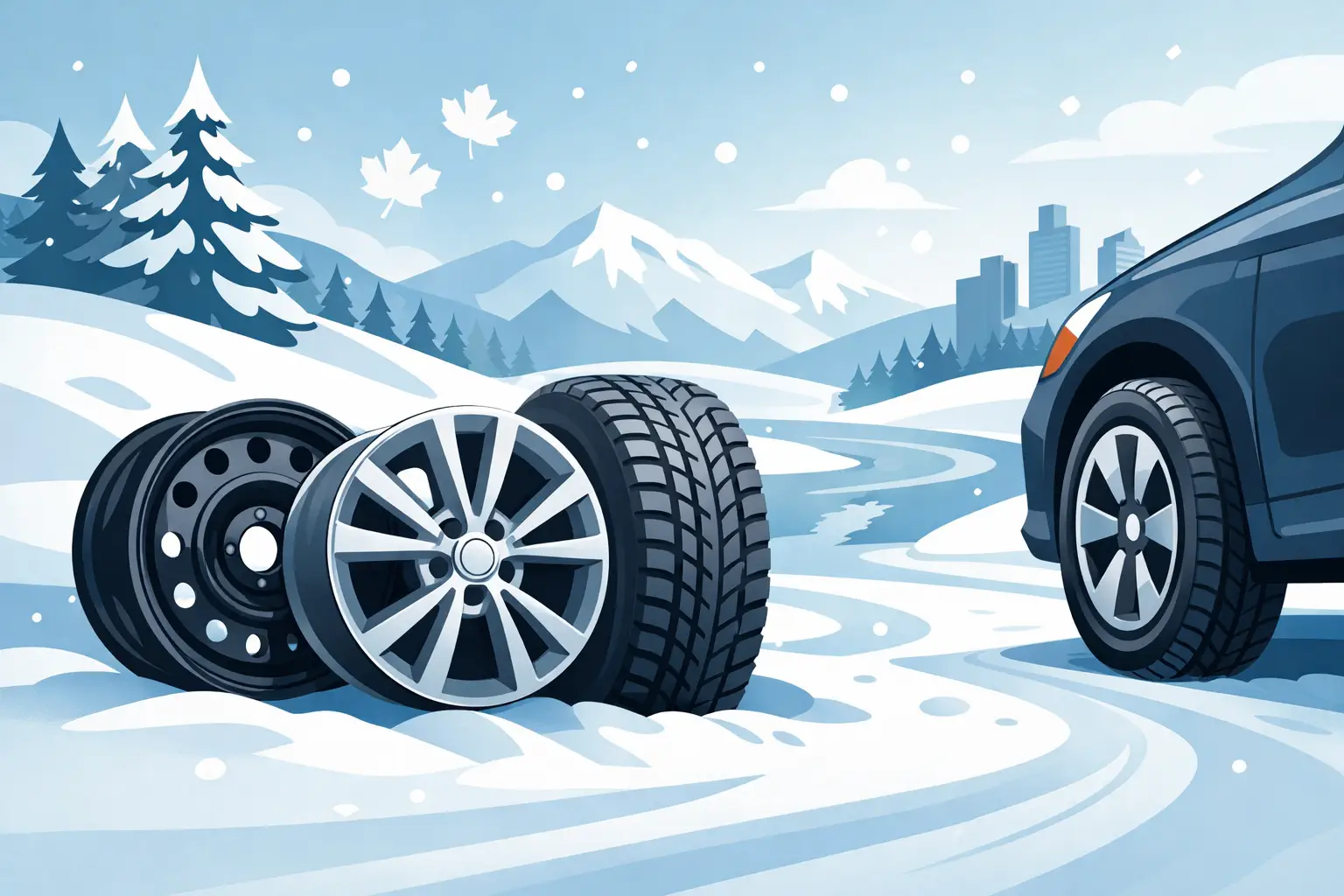
When the first snowfall hits, choosing the right winter tires is only part of the equation. The best winter wheels are the ones that stand up to road salt, potholes and temperature swings, and that match the correct specifications for your vehicle. A poorly chosen wheel can complicate installation, interfere with brake clearance, or create vibrations you'll feel all winter long.
In Quebec, the real question isn't just which wheel looks best or costs the least. You have to look at compatibility, durability and total cost of ownership. If you mount your winter tires on a second set of wheels, you save time at every seasonal changeover, you protect your summer rims, and you often reduce the risk of damaging the tire beads from repeated mounting and dismounting.
What are the best wheels for winter?
For most drivers, the simplest answer is still the steel wheel. It costs less, holds up well in tough conditions, and is easy to replace if it takes a serious hit. For everyday winter driving in Laval, Montreal or anywhere else in Quebec, it's often the most logical choice.
That said, an alloy wheel can also be a very good option. It all depends on the vehicle, the budget and your priorities. If you drive a newer vehicle with large brakes, some steel wheels simply won't fit. In other cases, alloy offers better weight control, a more precise fit, and sometimes better corrosion resistance depending on the quality of the manufacturing and finish.
So the right choice isn't universal. It depends on the type of car, the minimum approved diameter, the bolt pattern, the centre bore, the offset and the space available around the brake calipers.
Steel wheels for winter: the most practical choice
The steel wheel stays popular for one simple reason: it gets the job done without inflating the bill. For a lot of sedans, compact SUVs and crossovers, it's the most cost-effective solution when you want a reliable winter set.
Its main advantage is price. In winter, the roads are hard on your equipment. Between the road salt, blocks of ice and potholes hidden under the snow, a wheel can take a real beating. If a steel wheel gets damaged, replacing it is generally more affordable than replacing an alloy wheel.
You do have to accept a few trade-offs, though. Steel is heavier, which can slightly affect handling and fuel consumption. The finish is also more utilitarian. Over time, exposure to salt can speed up corrosion if maintenance is neglected. For many drivers, that's not an issue. The goal in winter is reliability and compatibility ahead of appearance.
Alloy wheels for winter: useful in plenty of cases
Alloy wheels aren't just for summer. A good model designed to handle northern conditions can serve you well in winter, especially on vehicles where clearance or weight constraints are tighter.
They can offer a better balance between performance and driving precision. On some vehicles, they're also easier to find in exact dimensions when you need to match a specific offset or clear a larger brake system. If you want to keep a cleaner look even through the cold season, alloy has a clear edge.
The thing to watch for is quality. A low-end alloy wheel with a fragile finish can age badly in salt and abrasives. So you shouldn't choose on price alone. In winter, a cheaper but poorly suited wheel can cost you more in the long run.
The criteria that really matter
When you compare the best winter wheels, the material is only a starting point. Dimensions and mechanical compatibility come first.
Diameter and width
Many vehicles let you drop down a size for winter, for example going from 18 inches to 17 inches if brake clearance allows. This strategy can lower tire costs and improve ride comfort on rough roads. But you should never improvise. The chosen diameter has to be approved for the vehicle.
Wheel width also has to match tire width. A poorly matched combination can affect road behaviour, wear and the quality of the fit.
Offset
Offset determines where the wheel sits relative to the hub. The wrong offset can make the wheel rub on the inside or outside, alter the steering geometry and create an unstable stance. It's a technical detail, but it changes everything.
Bolt pattern and centre bore
Two wheels of the same diameter can be completely incompatible if the bolt pattern or centre bore doesn't match. The centring has to be exact to avoid vibrations and ensure a safe installation. Hub-centric rings can help in some cases, but they don't fix a bad selection in the first place.
Brake clearance
This is often where mistakes happen. A wheel can look compatible on paper but lack the space around the caliper. This is especially important on many European vehicles, electric vehicles and recent models with larger brake assemblies.
Should you choose a smaller wheel in winter?
Often yes, but not always. A smaller wheel sometimes lets you fit a tire with a slightly taller sidewall, which helps on broken-up roads and can lower the purchase price. It's a common approach for winter in Quebec.
On the other hand, if your vehicle has large brakes, you may not have that room. Some models require you to keep a minimum diameter. You also have to keep the overall rolling diameter close to the original specifications so you don't throw off the odometer, the ABS or the driver-assistance systems.
TPMS, sensors and hardware
On many vehicles, it isn't enough to just buy four wheels and four tires. You also have to think about the TPMS sensors, the lug nut or bolt seats, and sometimes vehicle-specific hardware. A wheel that looks like a great deal can become less appealing if you have to add several unplanned components.
That's also one of the reasons a complete winter wheel-and-tire package is often simpler. Once the right set is installed and programmed as needed, seasonal changeovers are quicker and cleaner.
When steel is the best choice
If you rack up a lot of kilometres, park outside, want to keep the budget in check and are looking for a hassle-free solution, steel is hard to beat. It's generally the best starting point for everyday vehicles, compact SUVs and drivers who prioritize value for money.
For strictly winter use, it delivers what most people are after: a compatible, durable and affordable wheel that's easy to maintain and less stressful to replace if it gets damaged.
When alloy truly earns its place
If your vehicle calls for more precise specifications, if you need better brake clearance, or if you want a lighter, better-finished set, alloy can be the right investment. It also suits drivers who care about how their vehicle looks year-round.
You just have to make sure the model you choose is suited to serious winter use. Not all alloys age the same way against salt and abrasion.
How to avoid the most common mistakes
Mistake number one is buying on diameter alone. A 17-inch wheel tells you almost nothing on its own. Without the right bolt pattern, the right centre bore and the right offset, it can be unusable.
The second mistake is assuming a smaller size will always work in winter. That's often true, but only if the brakes leave the required space.
The third mistake is overlooking the Quebec context. A winter wheel has to be built for salted roads, freeze-thaw cycles and more frequent impacts. The cheapest purchase in the moment isn't always the most cost-effective after two or three seasons.
To avoid these problems, you need to validate the complete set against your vehicle's exact specifications. That's where a specialized retailer like Liqui Pneus brings real value, especially if you want to centralize the selection, installation and service in one place.
In the end, the best winter wheels are the ones that perfectly match your vehicle and your driving reality. If you're after the simplest solution, steel usually wins. If your vehicle imposes more constraints or you want a more precise result, alloy can be worth the difference. What matters is choosing a wheel that lets you get through winter with no nasty surprises at the first pothole, the first deep freeze or the first seasonal changeover appointment.