
Tire & Wheel Guides
Winter or All-Season Tires in Quebec?
Winter or all-season tires in Quebec? Compare grip, wear, cost, and safety to pick the right option for the way you actually drive.
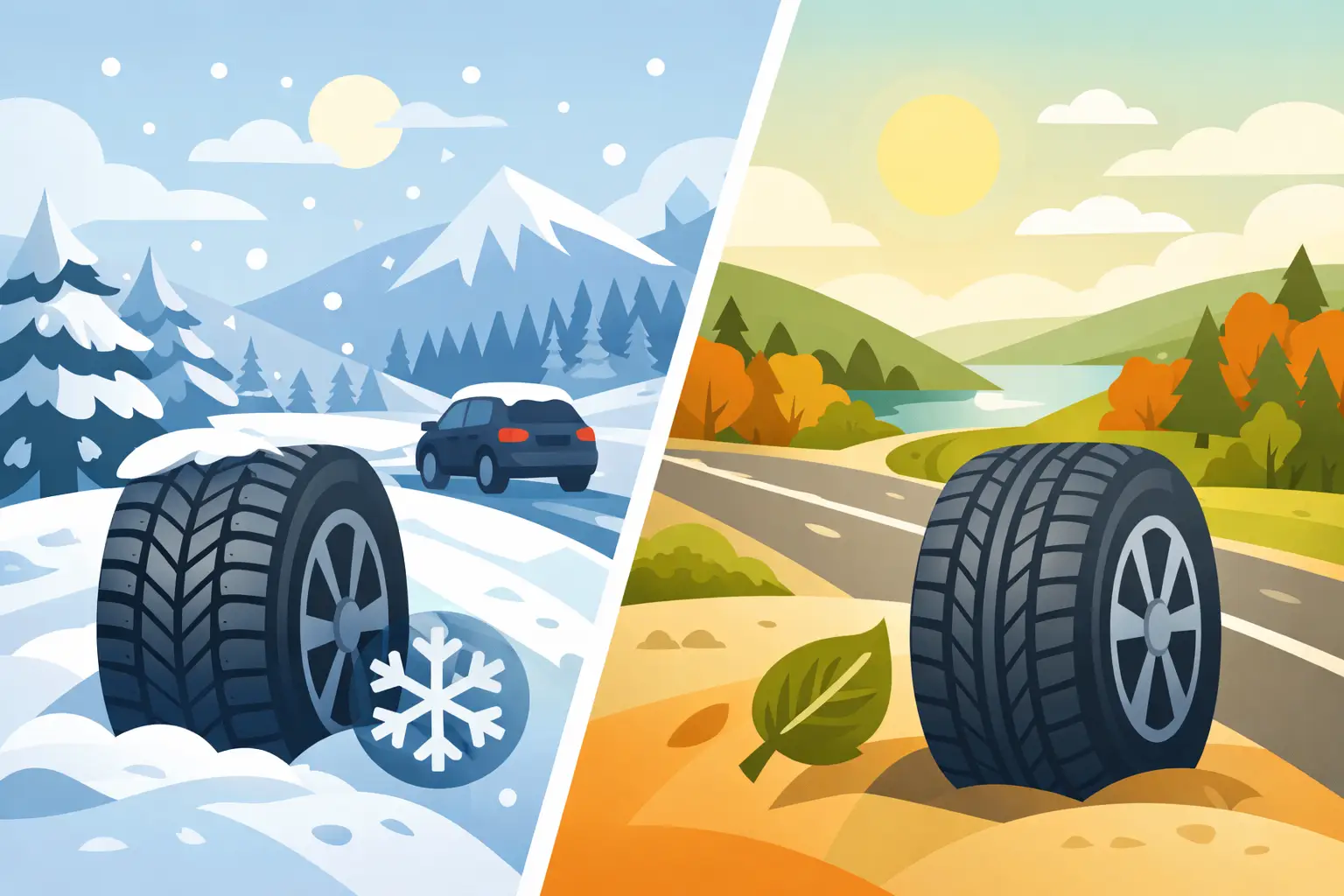
At the first snowfall, the question comes back quickly: winter or all-season tires? In Quebec, this choice isn't just theoretical. It affects your braking distance, your stability in corners, your traction when pulling away and, ultimately, your safety margin every single day.
The right answer depends far less on the marketing printed on the tire's sidewall than on your reality: your mileage, your area, the type of roads you take and the time of year you drive. If you mostly drive around the city in Laval, your needs aren't quite the same as a driver who hits the highway early in the morning, drives in rural areas or has to head out no matter the weather.
Winter or all-season tires: the real difference
A winter tire isn't just a tire with more grooves. Its rubber compound is designed to stay more flexible in cold weather. When the temperature drops, that flexibility helps the tire grip the road more effectively, whether it's cold, snow-covered, icy or simply wet. The result is tangible: better grip, shorter braking and more predictable handling.
The all-season tire, for its part, is built for versatility. It has to perform across a wider range of temperatures and conditions. That's handy, especially during the transition seasons, but this compromise has a clear limit: once a real Quebec winter sets in, it can't compete with a true winter tire on ice, packed snow and very cold pavement.
You also need to distinguish traditional all-season tires from all-weather tires. Many drivers mix the two up. A classic all-season tire is fine for year-round use in milder climates, but it isn't designed to handle a full Quebec winter. An all-weather tire, identified by the three-peak mountain and snowflake symbol, delivers better winter performance than a standard all-season. Even so, it generally still falls short of a dedicated winter tire when conditions get demanding.
What Quebec's climate really changes
In Quebec, the cold doesn't last a few days. It stretches over months, with sharp temperature swings, freezing rain, slush, storms and surfaces that change from one neighbourhood to the next. This context clearly favours the winter tire.
There's also the legal framework. For passenger vehicles registered in Quebec, winter tires are mandatory from December 1 to March 15. That point alone settles a big part of the debate for many drivers. If your vehicle is on the road during this period, a standard all-season tire isn't enough.
Even outside the mandatory period, the question still matters in the fall and spring. That's often when mistakes happen. On a morning at 2 or 3 degrees, with no snow in sight, a winter tire can already offer a real advantage on cold pavement. Conversely, keeping your winter tires on too late in the spring speeds up wear and can make driving less precise once temperatures climb back up for good.
When the winter tire is the right choice
If you drive every day, the winter tire is generally the most logical option. That's even more true if you do highway driving, if you leave early in the morning, if you have to drive during storms or if your vehicle is front-wheel drive and needs maximum traction when pulling away.
The winter tire is also a better fit for drivers who want more stable handling and fewer surprises. On a cold or icy road, the difference isn't only a matter of comfort. It's measured in seconds saved when braking and in control kept during an emergency manoeuvre.
For SUVs and light trucks, don't assume that weight or all-wheel drive can replace a good winter tire. All-wheel drive helps you get moving. It doesn't help you brake in a shorter distance. That's the tires' job.
When an all-weather tire can make sense
For some drivers, an all-weather tire can be an acceptable compromise outside the most demanding uses. That's often the case for a motorist who drives less, stays mostly in urban areas, avoids trips on the worst winter days and wants to limit seasonal tire swaps.
The main advantage is simplicity. A single set of tires, less handling, fewer appointments and no need for seasonal storage. For someone who uses their vehicle very little or has a high tolerance for compromise, that's a valid argument.
But you have to be clear-eyed about the trade-off. In severe winter conditions, an all-weather tire remains a versatile solution, not a specialized one. It can suit certain profiles, but it doesn't give you the same level of confidence as a dedicated winter tire when the road gets truly difficult.
Purchase price versus real cost
At first glance, choosing between winter or all-season tires can seem like a budget question. In practice, you have to look at the total cost over several seasons.
Buying two sets - summer or three-season on one side, winter on the other - calls for a higher upfront investment. On the other hand, each set wears more slowly since it's only on the road part of the year. That spreads out the wear and can make the combination more cost-effective in the medium term, especially if you keep your vehicle for several years.
With a single set of all-weather tires, you simplify management, but you use the same tire twelve months a year. So it wears continuously, and it has to handle very hot days just as much as cold, rain and snow. Depending on your mileage, the savings aren't always as clear as they seem at the outset.
You also have to factor in the indirect costs. Less effective traction in winter can mean more stress, more wasted time and, in the worst case, an avoidable incident. When it comes to tires, the advertised price is never the only number that counts.
Braking, road holding and wear: what you feel behind the wheel
Braking is the most telling criterion. That's often where the gap between the categories shows up the fastest. On a cold or slippery surface, the winter tire keeps more grip. The vehicle stays more stable, the ABS works in better conditions and stopping takes less room.
Road holding matters just as much. In a corner or during a lane change, a tire suited to winter responds with more consistency. The steering feels less vague, and the car corrects small surface variations more effectively.
On the wear side, it all depends on the season of use. A winter tire used in summer wears quickly and loses precision. An all-season tire used through a harsh winter can also degrade faster if it's often pushed to the limit of its grip. The right tire, in the right season, generally lasts better.
How to choose based on your driver profile
If you drive every day, make regular highway trips or can't postpone your travel, the winter tire remains the benchmark. If you drive little, mostly in the city, and are looking for a simpler solution outside of intensive winter use, an all-weather tire can make a case for itself depending on the vehicle and your tolerance for compromise.
If you have a heavier or more powerful vehicle, or one used for work, it's best to avoid choices that are too approximate. The right load index, the right size and a construction suited to your use matter just as much as the tire category itself.
That's also where a selection tool by vehicle or by size becomes useful. A tire that looks good on paper can be the wrong choice if it doesn't match the manufacturer's specifications or your type of use. At Liqui Pneus, this step saves time and avoids the costly mistakes that surface after the purchase.
Winter or all-season tires: the best decision is still the most realistic one
There's no universal answer, but some answers are more consistent than others. In Quebec, the winter tire remains the safest choice for the majority of drivers. The all-weather tire can be a good fit in specific cases, especially when simplicity is the priority and vehicle use stays moderate.
The most important thing is to choose based on your real trips, not your best-case scenarios. A dry road on a Saturday afternoon doesn't represent a January morning at 6:30. If you base your decision on the most demanding conditions you actually encounter, you're far less likely to get it wrong.