
Tire & Wheel Guides
When to Install Winter Tires in Quebec: The Right Timing
When should you install winter tires in Quebec? Temperature, the legal deadline, tread wear and booking ahead: how to pick the right moment to drive safer all winter long.
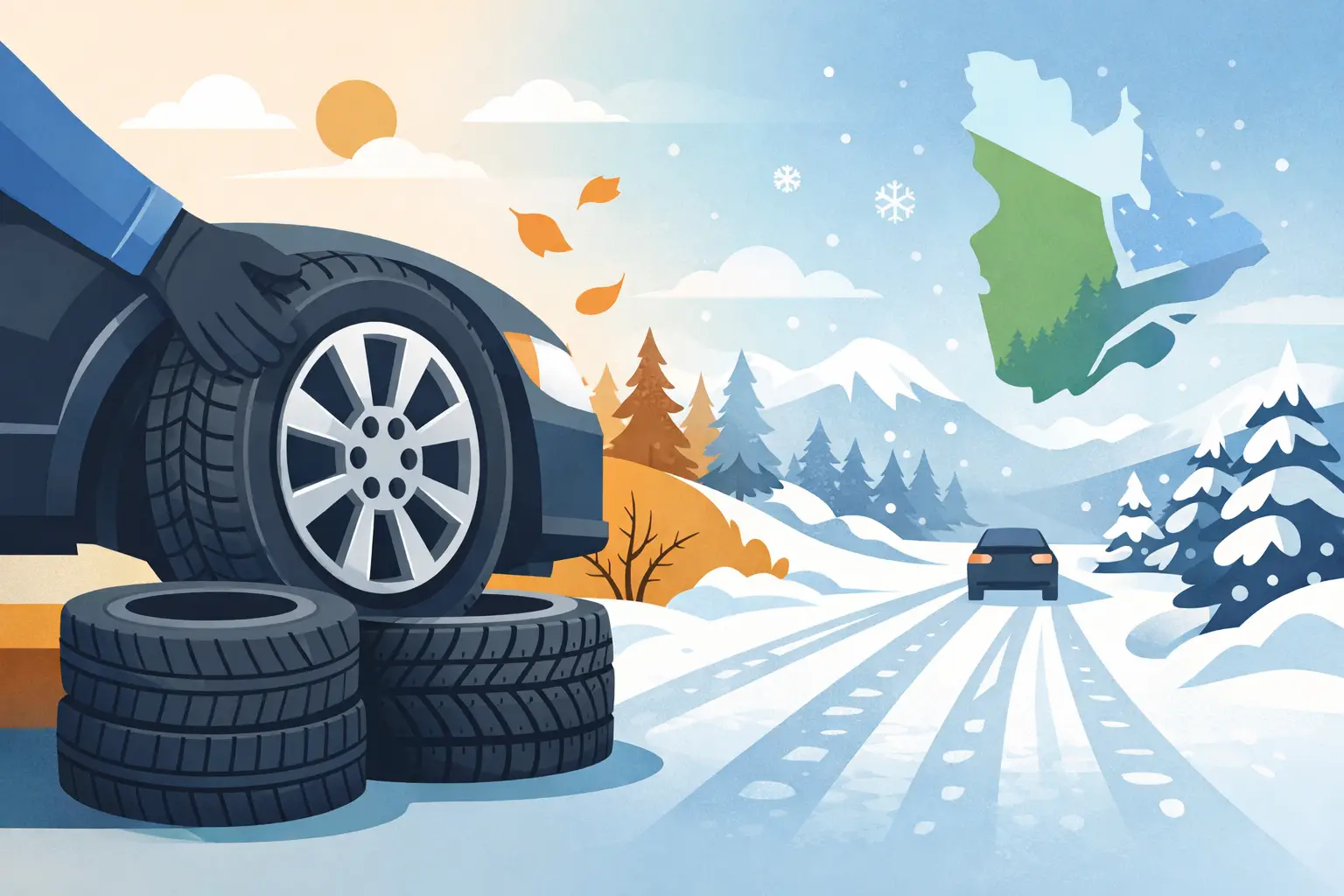
The right moment isn't decided the morning the first snow falls. If you're wondering when to install winter tires, the real answer often starts several weeks before the roads turn white. In Quebec, waiting until the last minute usually means fewer choices, busier shop schedules, and conditions that are already less than ideal for driving.
The best-known rule is simple: from December 1 to March 15, winter tires are mandatory on passenger vehicles registered in Quebec. In practice, though, that legal date shouldn't be your only reference point. A winter tire isn't only useful in the snow. It really starts to outperform as soon as the temperature drops to around 7 degrees Celsius, even on dry or wet pavement.
When to install winter tires: the real ideal window
For most Quebec drivers, the best stretch falls between mid-October and mid-November. This window lets you avoid the late-November rush, pick your tires without pressure, and get them installed before the first truly cold mornings arrive.
Why does this timing make sense? Because the rubber compound in a winter tire stays more flexible in the cold. Summer tires, and even some all-season tires, do the opposite: they stiffen as temperatures fall. The result is less grip under braking, less control through corners, and weaker traction when pulling away, especially on cold, wet, or icy surfaces.
If you drive early in the morning, late at night, or often on secondary roads, it pays not to wait. The thermometer might show an acceptable daytime average, but the real driving conditions are often colder during the hours you're actually on the road.
The legal date and good judgment aren't always the same thing
In Quebec, the law requires winter tires from December 1 to March 15. That's the regulatory minimum, not necessarily the best schedule for your safety. Installing your tires the day before December 1 may satisfy the law, but it isn't always the most sensible choice.
The same logic applies in the spring. Plenty of drivers pull their winter tires off as early as March 16. Yet in March, and even into April, it's not unusual to get black ice in the morning, a late snowfall, or very cold pavement. If temperatures stay low on a regular basis, it's better to wait a little before putting your summer tires back on.
So the right moment really comes down to three concrete factors: the actual temperature, the kind of driving you do, and your availability for the installation.
The 7-degree threshold: a better guide than the first storm
The roughly 7-degree Celsius threshold remains the most useful benchmark. Once the temperature regularly drops below that level, winter tires start to offer a clear advantage. This isn't a theoretical rule. It's directly tied to how the rubber compound behaves and how the tread is designed.
In other words, you don't wait for snow to be ready to face it. You gear up when conditions start to favour winter tires.
How you drive also changes the right moment
A driver who mostly makes short trips around the city doesn't have quite the same needs as someone who takes the highway every day between Laval, Montreal, and the North Shore. If you're driving kids around, if you have a fixed schedule to keep, or if your vehicle sits outside overnight, installing early is often the better call.
The same goes for SUVs, pickups, and other heavier vehicles. Weight is no substitute for grip. A heavier vehicle on the wrong tires also needs more distance to come to a stop.
How to tell it's already time to put them on
There are several very simple signs. If you're already scraping the windshield in the morning, if the pavement is cold at daybreak, if rain is becoming more frequent alongside low temperatures, or if your neighbourhood is seeing its first frosts, you're getting close to the right moment.
Another clue that often gets overlooked: the shop schedule. When appointment slots start filling up fast, it's a sign the season is turning. Waiting too long leaves you with less flexibility and sometimes forces you to install your tires in conditions that are already less pleasant.
For organized drivers, the ideal is to book early in the fall, especially if you also want a visual inspection, a balancing, or a full wheel swap done at the same time.
Install early or wait: the real trade-offs
Installing too late carries obvious risks. You can end up on the wrong tires just as conditions deteriorate. You also get caught in the seasonal rush, with tighter availability and sometimes more pressure to choose quickly.
Installing too early has a potential cost too. If the weather stays mild for several weeks, winter tires can wear faster on warm pavement. Their handling is also less precise than a summer tire's when it's genuinely hot out.
That's why the right decision isn't based on a fixed date alone. It rests on a balance. In Quebec, aiming for the point when the cold settles in for good remains the most cost-effective and the safest approach.
Don't rely on the tire's appearance alone
A winter tire can look fine to the eye and still no longer deliver the performance you expect. Tread wear matters, of course, but the age of the tire, the hardening of the rubber, and uneven wear all play a part too.
If your tires already have several seasons on them, ask yourself a simple question: do I want to spend another full winter with this level of grip? If you're hesitating, that's usually a sign a check-up is in order.
A badly worn tire quickly loses its effectiveness in slush, water, and packed snow. And if you wait until installation day to discover they need replacing, you'll be juggling the purchase, the fitment, the booking, and sometimes the storage all at once. That scenario usually costs more in time than in money.
Tires on rims or a straight swap: it changes the planning
If your winter tires are already mounted on their own rims, the installation is generally faster and easier to schedule. It's also a practical way to limit the repeated handling of the tires every time the season changes.
If the tires have to be dismounted and remounted on the same wheels, the appointment takes more time and a bit more organization. In that case, booking ahead becomes even more important, especially in peak season.
For many drivers, the full-wheel format simplifies everything: installation, storage, wear, and how quickly the job gets done. It's especially worthwhile if you plan to keep your vehicle for a few years.
Storage is part of the right answer
Knowing when to install winter tires also means knowing what to do with the other set. Poor storage can speed up the aging of the rubber and complicate the next season. Temperature, humidity, positioning, and cleanliness all have a real impact.
If you're short on space at home or want to avoid the heavy lifting, a tire storage service removes a major source of friction. For a lot of drivers in Laval and the surrounding area, the benefit isn't only logistical. It's also a way to keep the process simple, fast, and more predictable from one season to the next.
What to check before your appointment
Before the installation, confirm the exact size of your tires, their compatibility with your wheels, the overall condition of the set, and the tread depth. If your vehicle has a tire pressure monitoring system, it's also worth verifying the intended setup.
This matters even more if you're changing vehicles, buying a new set, or switching to a different format. Width, diameter, load index, speed rating, and wheel compatibility are not minor details. A mistake here can cost you time, money, and lower performance on the road.
In a practical model like the one at Liqui Pneus, the advantage is clear: you can centralize the selection, the compatibility check, the installation, and even the storage without piling on extra steps.
The best time is before you urgently need it
In Quebec, the smart move isn't to wait for the first big dump of snow. The smart move is to plan your changeover as the cold settles in, as the roads become less predictable, and while there's still room in the schedule. You gain in safety, in efficiency, and in peace of mind.
If you're still on the fence, just look at your next week of driving. Not the ideal forecast, but your real routine: early departures, late returns, cold rain, wet pavement, frost on the ground. That's often where the answer becomes obvious.