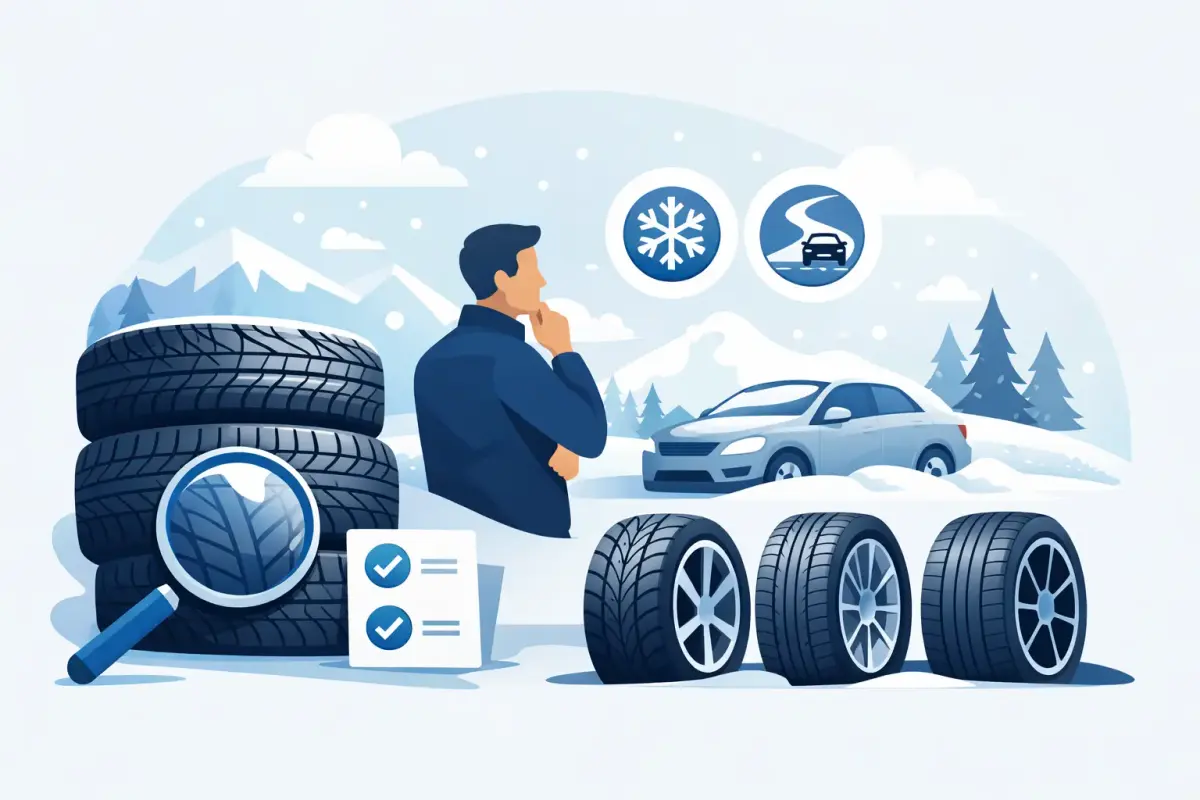
An effective winter tire relies on a refined combination of a cold-adapted rubber compound, a relevant tread design, and a physical condition fully capable of handling winter road surfaces. Beyond manufacturing characteristics, real-world effectiveness also depends on proper installation, consistent maintenance, and prudent driving practices. Understanding how these distinct factors interact allows drivers to choose their tires based on engineering reality rather than relying solely on tread pattern photographs or marketing promises.
The Rubber Compound: Maintaining Useful Contact in Cold Weather
The flexibility of the rubber compound is paramount because a tire must continually conform to micro-irregularities in the road surface to generate grip. Transport Canada emphasizes that summer and all-season tires lose their elasticity as temperatures drop, whereas winter tires are specifically engineered to retain their pliability at lower temperatures. The widely cited 7 °C threshold serves as a helpful seasonal preparation guide for drivers rather than a rigid physical boundary at which all tires instantly change behavior.
The exact formulation of the rubber matrix varies significantly depending on the tire model and manufacturer design goals. Proprietary compound branding can help identify a manufacturer's technological family, but it cannot replace a thorough evaluation of the complete tire. Drivers should avoid judging the quality or grip potential of a tire simply by pressing or feeling the rubber on a display unit in a heated retail showroom. That tactile impression inside a warm store provides no reliable measurement of actual braking distance or cornering traction on icy Canadian roads.
Sipes and Tread Pattern: Multiple Complementary Functions
The small incisions engineered into tread blocks, known as sipes, work alongside the defined block edges of the tread pattern to bite into slippery winter surfaces. Simultaneously, the surrounding circumferential and lateral grooves handle the evacuation of water and slush away from the contact patch. Consequently, an aggressively styled tread pattern does not automatically prove superior performance on glare ice; one must evaluate the specific engineering objectives of the model and the exact driving conditions it was designed to encounter.
Significant variations in tread patterns or tire characteristics between different wheels on the same vehicle can disrupt handling dynamics and vehicle balance. Transport Canada recommends fitting four matching, compatible winter tires to preserve overall vehicle stability and directional control. Building a set by simply placing two higher-grip tires on the drive axle is strongly discouraged. Furthermore, when a vehicle relies on factory-staggered fitments where front and rear tire dimensions differ, drivers must carefully follow the specific configuration requirements defined by the vehicle manufacturer.
Winter Markings Provide a Benchmark, Not a Universal Ranking
The three-peak mountain snowflake symbol, frequently designated as 3PMSF, confirms that a tire meets specified minimum snow traction criteria under standardized test conditions. However, this marking does not rank tires against one another or reflect performance across every distinct winter surface, such as black ice or wet asphalt. Two separate tire models bearing the identical pictogram can exhibit vastly different design focus and handling behavior. The basic M+S (Mud and Snow) designation alone is not a sufficient verification when choosing a tire designed for Quebec winter driving conditions.
The recommended approach is to verify the presence of the winter marking and then conduct a comprehensive comparison based on actual driving needs: frequency of ice encountered, deep snow navigation, clear plowed highway driving, ride comfort, and overall vehicle compatibility. An official pictogram does not constitute a guaranteed stopping distance in real-world scenarios. Available traction is always dependent on road conditions, vehicle weight, electronic driver aids, and weather changes. Drivers must always maintain safe braking margins and adapt their road maneuvers accordingly.
Tread Wear and Inflation Pressure: Model Design Isn't Everything
A tread depth that remains acceptable under dry or mild driving conditions can prove far less effective on heavily snow-covered or slushy roadways. Transport Canada recommends against using tires on snow when their tread depth has worn down close to 4 mm (5/32 in). This safety benchmark should be understood as a practical guideline for winter performance rather than a contractual warranty threshold or a mandatory legal minimum. Have tire depth measured accurately across multiple grooves, and check for uneven wear patterns between different positions on the vehicle.
Inflation pressure must be checked routinely according to the vehicle manufacturer's recommended cold pressure specifications. Automated tire pressure monitoring systems (TPMS) provide helpful alerts, but they do not replace regular manual checks with a calibrated gauge. Repeated pressure loss, tread wear concentrated on a single side, or persistent steering vibrations warrant a detailed professional inspection. Even a highly rated winter tire model cannot overcome underlying issues related to improper mounting, incorrect wheel alignment, or worn suspension components. Address these mechanical symptoms before installing a fresh set of tires.
Selecting Tires Based on Your Everyday Driving Routes
Begin your selection process by describing the specific driving routes that present the greatest challenges during your winter routine: steep urban hills, unplowed secondary roads, early morning commutes prior to road maintenance, or high-speed highway travel. Defining these concrete scenarios provides an accurate foundation for comparing tire attributes. From there, confirm the exact tire dimensions, load index, and speed rating required for your specific vehicle before reviewing available products in that exact size setup.
Our winter tire selection and tire brand guides are designed to help you construct a refined shortlist of suitable options. To convert your shortlist into an accurate quote, contact Liqui Pneus in Laval with your complete vehicle specifications. Request explicit product references, verify included installation services, and maintain thorough ongoing maintenance documentation. Optimum winter driving effectiveness is built through an appropriate choice supported by rigorous maintenance, not by relying on a model name alone.
FAQ
Frequently asked questions
Is a wider tire automatically better in winter conditions?
No. Tire dimensions must be validated specifically for your vehicle. Width, diameter, or visual appearance alone do not guarantee improved winter traction.
Does the 3PMSF symbol guarantee the best braking performance on ice?
No. It provides a standardized baseline for snow traction, but it does not rank products against each other across all winter surfaces such as glare ice.