 Dymag
DymagWheel brand
Dymag
Dymag is a British high-performance wheel manufacturer founded in 1974, specializing in ultralight wheels made of magnesium, forged aluminum and composite.
PerformanceForgéHiver / OEMCanadienEuropéen
Dymag official websiteDocumented profileManufacturing, positioning and key models presented clearly.
Fitment checkedBolt pattern, offset, centre bore and load must match the vehicle.
Live cataloguePrices, finishes, sizes and stock are checked while shopping.
Encyclopedia profile
History, reputation and uses
Dymag (Dymag Performance Wheels) is a British company founded in 1974 by Max Boxstrom, and today based in Chippenham, England. Its roots are deeply anchored in motorsport: as early as the 1970s, Dymag developed cast magnesium wheels for Formula 1 and invented the first three-spoke magnesium motorcycle racing wheel. The brand built a reputation as an innovator in reducing unsprung mass and rotational inertia. In 1995, Dymag launched the first carbon composite motorcycle wheel certified for road and track use; in 2004, it became the first in the world to bring hybrid carbon automotive wheels to market. After a difficult period, the company was relaunched in 2011 under the leadership of CEO Chris Shelley and key former employees. Dymag has since developed, in partnership with the National Composites Centre (NCC) in Bristol, its Boxstrom hybrid wheel, named in honor of the founder and protected by a British patent and PCT coverage in more than 140 countries. On the manufacturing side, Dymag covers several processes depending on the range: forged and extruded aluminum (UP7X motorcycle range, forged automotive wheels), carbon composite (CA5 motorcycle wheels) and a hybrid construction combining a carbon barrel with a high-specification forged aluminum center (Boxstrom, automotive Carbon Hybrid). This hybrid approach optimizes the load path, eliminates stress concentrations and incorporates a protective sacrificial layer; the result is a wheel up to 40% lighter than a cast alloy wheel and significantly lighter than an OEM forged wheel, with a moment of inertia reduced by 30 to 40%. Dymag wheels are fitted to prestige sports cars (Porsche, Corvette) as well as competition motorcycles racing in World Superbike, British Superbikes and at the Isle of Man Tourist Trophy since 2014. The brand targets a demanding clientele, focused on performance and exclusivity rather than volume.
Recommended use: Dymag is aimed first and foremost at performance vehicles: sports cars and supercars (Porsche 718/911, Corvette C7, etc.) looking to reduce unsprung mass, and modern 600 to 1000 cc sport motorcycles for road, track or racing use. The carbon and hybrid carbon ranges target the most demanding use (track days, competition, prestige), while the forged aluminum ranges (UP7X on the motorcycle side) offer a performance/durability compromise certified for the road. These are premium aftermarket wheels; some applications also serve as original equipment or a factory option on niche vehicles. Of little relevance as a utilitarian winter wheel in Quebec: they are reserved for summer, collector or track vehicles.
Technologies and manufacturing: Dymag masters several processes. Forged and extruded aluminum (the UP7X motorcycle range) produces robust wheels that are significantly lighter than stock. The CA5 motorcycle wheels are made of carbon composite, with a proprietary weave and ply orientation, achieving remarkable weights (around 2.2 kg at the front). The hybrid carbon construction (Boxstrom, automotive Carbon Hybrid) marries a carbon barrel to a forged aluminum center, with load-path optimization and a sacrificial layer; developed with the National Composites Centre and patented. The Boxstrom barrel passed more than 2.5 million radial fatigue cycles. The wheels are certified to the JWL, BS AU 50 and DOT standards.
Key takeaways
- Positionnement très technique.
- Pertinent pour supercars, motorsport et réduction de masse extrême.
Strengths
- Authentic racing heritage (F1, GP motorcycles) since 1974
- World pioneer of carbon motorcycle wheels (1995) and hybrid carbon automotive wheels (2004)
- Among the lightest wheels on the market, with strongly reduced rotational inertia
- Patented Boxstrom technology, developed with the National Composites Centre
- Recognized certifications (JWL, BS AU 50, DOT) and WSBK/BSB/Isle of Man pedigree
Points to check
- Very high price, exclusive and niche positioning
- Carbon and hybrid ranges sensitive to impacts (potholes), difficult to repair
- Limited availability of applications and sizes depending on the vehicle
- Fitment must be validated carefully (bolt pattern, offset, center bore, brake clearance, TPMS)
- Poorly suited as a winter set for Quebec salt and calcium; reserve for summer/track use
Models & families
Dymag wheel models
Boxstromforgée
The Boxstrom is Dymag's flagship carbon hybrid automotive wheel, named in honor of founder Max Boxstrom. The product of two years of research and development with the National Composites Centre in Bristol, it is protected by a UK patent and PCT coverage in more than 140 countries. Its construction pairs a carbon composite barrel with a high-specification forged aluminum center: the load path is optimized to eliminate stress concentrations, and a sacrificial layer protects the load-bearing structure. The barrel has validated more than 2.5 million radial fatigue cycles, at loads close to triple those seen at the corner of a passenger car. The gain is major: up to 40% lighter than a cast alloy wheel, about 25% less than an equivalent OEM forged wheel, with a moment of inertia lowered by 30 to 40%. Intended for prestige sports cars and supercars, it comes in finish versions (graphite, satin black). In Quebec, it is a summer or track wheel: validate bolt pattern, offset, center bore, brake clearance and TPMS, and avoid exposure to road salt.
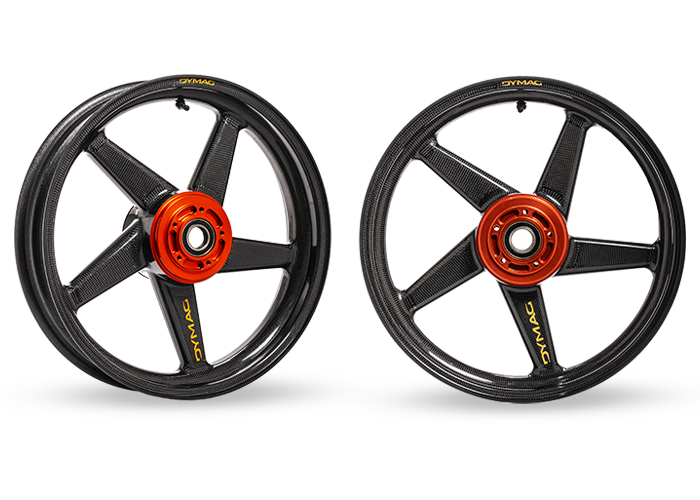
View the model profileCA5coulée performanceThe CA5 is a Dymag carbon composite motorcycle wheel with five spokes, designed for racing and the most demanding use. Made with a proprietary weave and optimized ply orientation, it reaches exceptionally low weights: as a guide, about 2.2 kg complete at the front and 2.9 kg complete at the rear on a Ducati application. This extreme lightness sharply reduces rotational inertia and the gyroscopic effect, improving handling, lean-in, acceleration and braking, making it a benchmark for track days and competition. Like any carbon wheel, it requires careful use: increased sensitivity to curb or debris impacts, rigorous inspection after any impact, and specialized repair. Certified to international standards (JWL, BS AU 50, DOT). In Quebec, the CA5 is for the track/sport motorcyclist and not for winter or everyday use on rough roads; validate the motorcycle application, the hub and the brake system before ordering.
View the model profileCarbon HybridforgéeThe Carbon Hybrid range is Dymag's signature approach for automotive applications: a carbon composite barrel mated to a high-specification forged aluminum center. This multi-material construction combines the stiffness and lightness of carbon at the wheel's periphery, where reducing inertia matters most, with the strength and durability of a forged center at the hub and fasteners. The result is a wheel up to 40% lighter than a cast alloy and significantly lighter than an OEM forged wheel, with a moment of inertia reduced by 30 to 40%, improving acceleration, braking and driving precision. The load path is optimized to eliminate stress concentrations, and a sacrificial layer protects the load-bearing structure. These wheels target prestige sports cars and supercars (Porsche, Corvette, etc.) for road and track use. In Quebec, they suit a summer or collector vehicle; fitment (bolt pattern, offset, center bore, brake clearance, TPMS compatibility) must be validated per application, and winter use with road salt is not recommended.
View the model profileMotorcycle Wheelsflow formedThe Motorcycle Wheels range gathers Dymag's entire motorcycle lineup, which covers two main construction families: forged and extruded aluminum (the UP7X range, robust and road-certified) and carbon composite (the CA5 range and carbon wheels, for racing and extreme performance). Heir to Dymag's invention of the first road-certified carbon motorcycle wheel in 1995, this range targets modern 600 to 1000 cc sport bikes as well as certain older motorcycles via dedicated options. The common objective is the reduction of unsprung mass and rotational inertia, which transforms handling, lean-in, acceleration and braking. The competition pedigree is solid: World Superbike, British Superbike and the Isle of Man Tourist Trophy since 2014. The wheels are certified JWL, DOT and BS AU 50. The choice of forged versus carbon depends on use: daily road use and robustness favor forged aluminum, while track use and the pursuit of minimal mass point toward carbon. Always validate the exact application, the hub, the offset and the brake system.
View the model profileUP7Xflow formedThe UP7X is Dymag's flagship motorcycle wheel in forged and extruded aluminum, designed for modern 600 to 1000 cc sport bikes. Its reworked spoke design incorporates lightening holes to reduce mass while retaining strength, making it about 7% lighter than the UP7AL it replaces. On a model like the Kawasaki ZX-10R, the front comes in around 3.36 kg (versus 4.45 kg stock) and the rear at about 5.62 kg (versus 7.60 kg), a gain of nearly 25% overall. Available in 17 x 3.5 in front and 17 x 4.5 / 5.5 / 6.0 in rear, with options for older motorcycles. The UP7X has a strong competition record: wins at the Isle of Man Tourist Trophy (Michael Dunlop) and in British Superbike (Ryuichi Kiyonari) starting in 2014. Certified for road and racing (JWL, DOT, BS AU 50), it is the robust forged choice for those who want to lighten their bike without going to carbon. Verify the exact application and offset before purchase.
View the model profileTechnical
What to confirm for a compatible wheel
fitment
Point technique à valider selon le véhicule, l'usage, la dimension et les recommandations du fabricant.
entraxe
Le bolt pattern doit correspondre exactement au moyeu du véhicule. Une approximation rend la roue incompatible.
offset
Le déport détermine la position de la roue vers l'intérieur ou l'extérieur et influence le dégagement des ailes et des freins.
alésage central
Le center bore doit être compatible avec le moyeu ou corrigé avec des bagues de centrage adaptées.
indice de charge
La jante doit supporter la charge du véhicule, surtout pour VUS, camionnettes, remorques et usages commerciaux.
TPMS
Point technique à valider selon le véhicule, l'usage, la dimension et les recommandations du fabricant.